
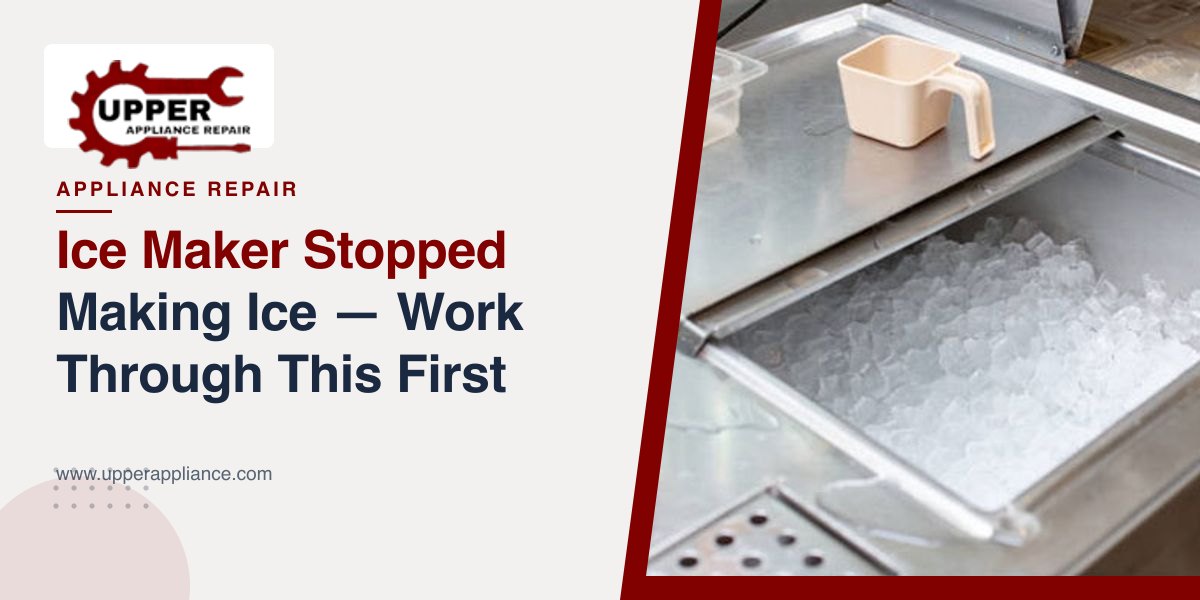
The ice maker generates more service calls than any other single component on a modern refrigerator. It is also the component with the most causes you can rule out yourself before calling anyone.
Check these first
1. The arm or switch
Almost every ice maker has a shut-off — a wire arm that rides on the ice, or a switch on the front. It gets knocked into the off position when someone reaches into the freezer. Check it before anything else.
2. Freezer temperature
Ice makers need roughly 0°F to 5°F. A freezer running warm because it is overloaded, because the door is not sealing, or because the defrost cycle is struggling will produce little or no ice while everything else seems fine.
3. The water line
Look behind the fridge. A kinked supply line is common after the appliance has been pulled out for cleaning. The shut-off valve may also be partly closed.
4. A frozen fill tube
The small tube feeding water into the mould can freeze solid. A hair dryer on low, held well back, clears it — but if it refreezes within days something upstream is wrong.
What the symptom tells us
Hollow or half-formed cubes point at flow, not freezing. The mould is not filling completely — a partly blocked inlet screen, a failing fill valve, or low supply pressure.
Cubes fused into a block usually mean slow production combined with a freezer that is cycling oddly, or an ice maker running when the bin is already full.
Ice that tastes or smells wrong is normally the filter, not the ice maker. Filters have a service life; past it they stop helping and start contributing.
Nothing at all, arm on, freezer cold is usually the fill valve or the module itself, and that is where we start.
Hard water shortens ice maker life
Mineral builds on the fill valve and inlet screen, flow drops gradually, and cube quality degrades before production stops entirely. In hard-water areas this is the most common path to failure — which is why we check water quality as part of the diagnosis rather than replacing the module and hoping.
When to call
If the arm is on, the freezer is properly cold, the line is clear and there is still no ice, the fault is in the valve, the module or the wiring — and those need testing rather than guessing.
How an ice maker actually works
Understanding the cycle makes the symptoms readable. A water valve opens for a fixed number of seconds and fills the mould. The freezer freezes it. A thermostat or sensor detects the mould has reached temperature, a small heater briefly warms the underside to release the cubes, and a motor rotates the ejector arms to sweep them into the bin. The arm then rests on the ice; when the bin fills, the arm cannot drop and production stops.
Note what that means: the valve fills for a set time, not to a set level. If pressure is low or the screen is partly blocked, the mould gets less water in the same seconds — which is exactly why hollow cubes point at flow rather than freezing.
Symptom to cause
- Small or hollow cubes — restricted flow: inlet screen, valve, supply pressure, or a partly frozen fill tube
- No cubes, arm down, freezer cold — fill valve, module, or wiring
- Cubes made but not ejected — ejector motor, mould heater, or cubes frozen into the mould
- Cubes fused into a block — slow production, or an ice maker cycling while the bin is already full
- Overflowing, water in the freezer — the valve is not closing fully, often mineral on the seat
- Ice tastes wrong — filter past its life, or old ice absorbing freezer odours
Checks you can do safely
Empty the bin completely
Old ice sublimates, fuses, and shrinks. A bin of old cubes can hold the arm up and stop production entirely while looking full and healthy. Empty it, wash it, put it back.
Check water pressure at the fridge
If the dispenser fills a glass slowly, the ice maker is receiving the same weak supply. That points upstream of the ice maker — shut-off valve, saddle valve, or filter.
Change the water filter
A filter well past its rated life restricts flow significantly. It is the cheapest thing on this list and it resolves a meaningful share of complaints.
Confirm freezer temperature with a thermometer
Not the display — a separate thermometer. Ice makers need roughly 0°F to 5°F and will produce little above that.
After a power cut or a move
Ice makers frequently need a reset following an interruption, and many have a test button or a documented reset sequence. It is also normal for the first batch after a filter change to come out cloudy or off-tasting — air in the line. Discard the first two or three batches before deciding something is wrong.
Common questions
How long should a new ice maker take to start?
Up to 24 hours for the first cubes, and a couple of days to reach normal output. Do not judge it on the first evening.
Why does my ice smell like the freezer?
Ice absorbs odours readily, especially old ice sitting in an open bin. Empty it, and store strong-smelling food sealed.
Is a standalone ice maker better?
It produces more and recovers faster, which matters if you use a lot. It is also another appliance to maintain, and it is equally affected by hard water.
Can the ice maker be replaced as one unit?
On most refrigerators the module is a serviceable assembly, which keeps the repair contained. Whether that or a valve is the right fix depends on the test results, not the symptom alone.
Book a visit or call (832) 615-1079 and we will tell you what the fault is before any part is ordered.