
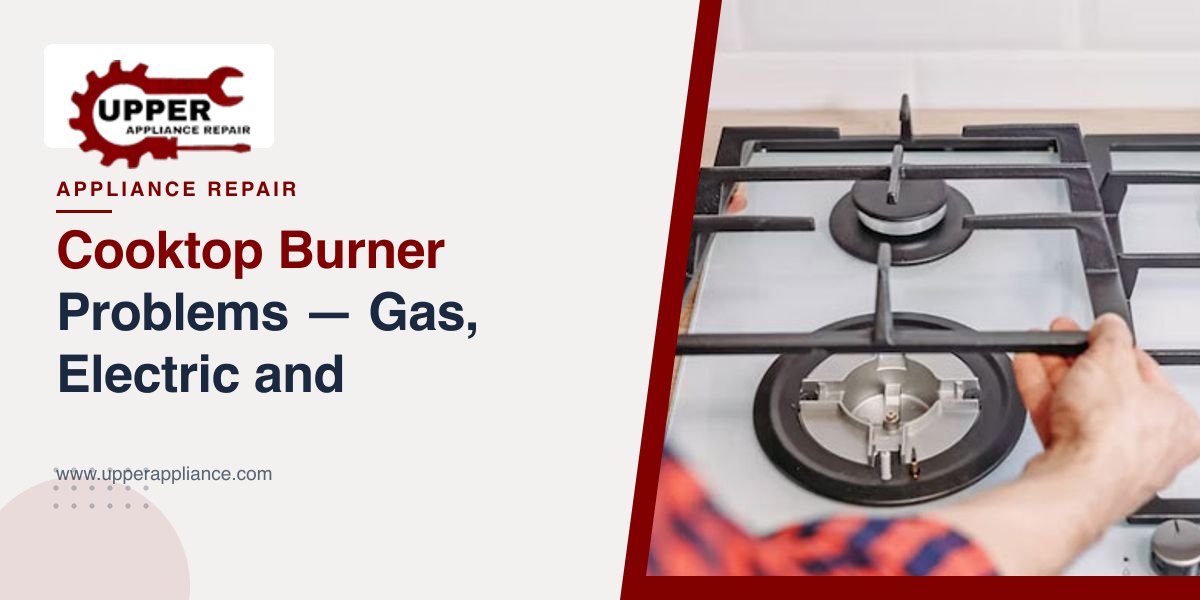
Cooktops fail differently depending on how they make heat. Knowing which type you have narrows the cause immediately.
Gas: clicking that will not stop
The most common gas complaint. The igniter keeps sparking even after the flame lights, or it clicks with no burner turned on at all.
Almost always moisture or debris around the igniter — a boil-over, a spill, or a recent clean where water got into the electrode. Switch the burner off, let everything dry completely, and clean carefully around the electrode and burner cap. If it persists after a full day of drying, the switch or the spark module needs attention.
One gas burner will not light, the others do
Work through it in this order, all with the gas off:
- Burner cap seated correctly. Lift and reseat it — the most common cause and free to fix.
- Port holes blocked. Food debris clogs the small holes around the burner ring. A stiff brush or a pin clears them.
- Electrode dirty or wet. Clean gently; it is ceramic and brittle.
- Burner head not level. A cap sitting crooked gives an uneven or partial flame.
Yellow or orange flame
A healthy gas flame is blue with a small inner cone. Yellow or orange means incomplete combustion — usually a blocked port or an air-shutter adjustment. It also deposits soot on pans. This is worth a technician: incomplete combustion produces carbon monoxide, and that is not a symptom to live with.
One genuine exception: a brief orange flicker as dust burns off is normal, particularly in a new or recently cleaned appliance.
Electric coil and radiant
One element does not heat
On coil cooktops, the element plugs into a receptacle. Switch off at the breaker, unplug the element, and check for burnt or corroded contacts. A damaged receptacle is as common as a failed element and cheaper to replace.
On smooth radiant tops the element is under the glass and not user-serviceable. A dead zone there is a technician job.
Element stuck on high
An infinite switch that has welded closed. It stops responding to the dial and runs full power regardless. Switch off at the breaker and stop using that zone — this is a burn and fire risk, not an inconvenience.
Cycling on and off
Normal. Radiant elements cycle to hold an average temperature; they do not modulate smoothly the way gas does.
Induction
The hob does not recognise the pan
Induction needs ferrous cookware. If a magnet does not stick firmly to the pan base, that hob will not heat it. Aluminium, copper and most stainless without a magnetic base will not work.
Pan size matters too: a small pan on a large zone may fall below the detection threshold.
It powers down mid-cook
Usually thermal protection. Induction electronics sit directly under the glass and need airflow; blocked vents underneath, or a very long high-power session, will trigger a shutdown. Check that nothing is obstructing the vents in the cabinetry.
A fan running after everything is off
Normal and desirable — it is cooling the electronics.
Cracked glass is a stop
Any crack in a glass cooktop, radiant or induction, means stop using it. Liquid reaching the electronics underneath creates a shock hazard, and cracks propagate under heat. This is not something to keep using carefully.
Common questions
Why do the grates on my gas cooktop discolour?
Normal with heat over time. Discoloured grates still work; a warped one that rocks does not sit pans safely and should be replaced.
Can I use cast iron on induction and glass?
On induction, yes — it works extremely well. On radiant glass, yes but carefully: cast iron is heavy and rough, and dragging it scratches the surface. Lift, do not slide.
My gas burner flame is smaller than it used to be.
Usually blocked ports. If cleaning does not restore it and every burner is weak, the supply pressure or regulator needs checking — that is a technician job.
Is a burner that lights slowly a problem?
It usually means a partly blocked port or a weakening igniter. Neither is urgent, and both get worse.
Book a visit or call (832) 615-1079 and we will tell you what the fault is before any part is ordered.